
Rubik’s Cube
 | to | 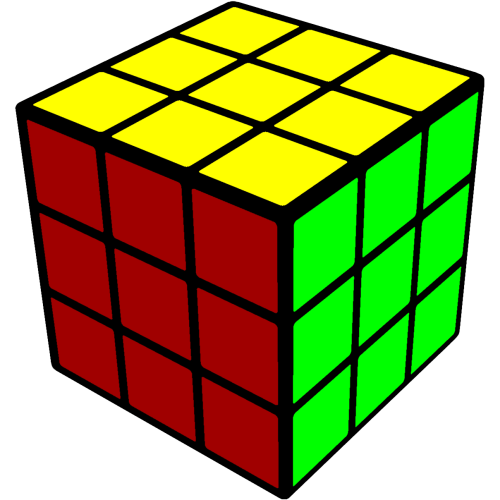 | in under 2 minutes |
|---|
In the 2020 lockdown I learned how to solve a 3x3x3 Rubik’s Cube by following a set of videos by Cubastic. While it’s not the quickest way to solve a 3x3x3 cube, it is really easy and these notes remind me of the steps using this method.
You could learn this method by following these notes but the videos are great and walk you through it. Use the “show ...” buttons for more details.
| 1 algorithm | (reversed) | |||||||||||||
|---|---|---|---|---|---|---|---|---|---|---|---|---|---|---|
| right hand: | RH | = | R | U | R' | U' | RH' | = | U | R | U' | R' | ||
| left hand: | LH | = | L' | U' | L | U | LH' | = | U' | L' | U | L | ||
| result | algorithms and notes | ||||
|---|---|---|---|---|---|
| 1 | white edges |  | (around yellow centre) | ||
| |||||
| 2 | white cross | 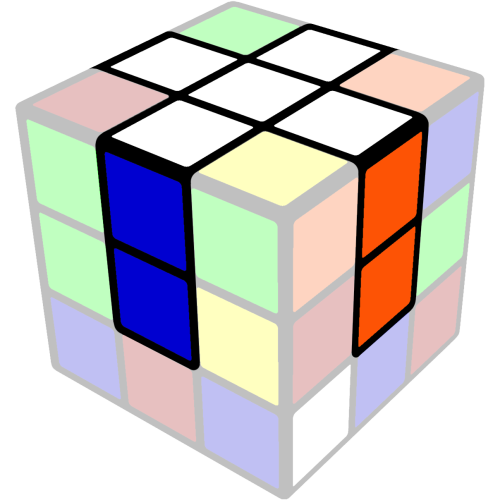 (bottom view) | F2 | ||
| |||||
| 3 | white layer |  (bottom view) | RH | or RH' | |
| |||||
| 4 | middle layer |  | RH5 y LH5 | = RH' y LH' | |
| |||||
| 5 | yellow cross | 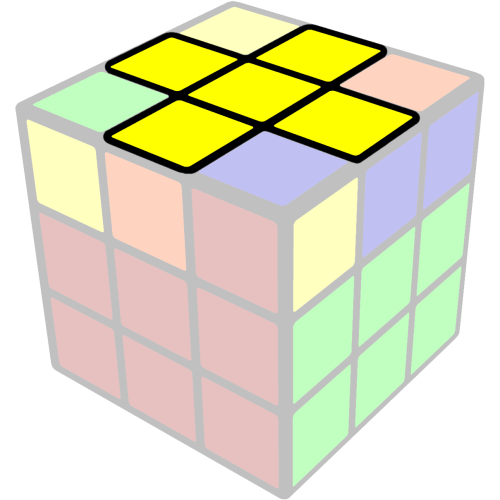 | F RH F' | or F RH' F' | |
|  | ||||
| 6 | locate corners | 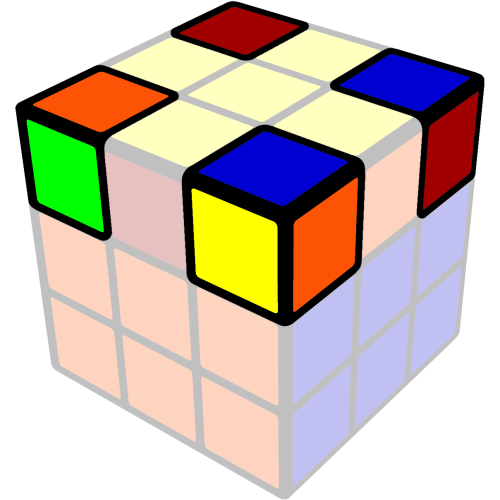 | RH3 y LH3 | ||
| |||||
| 7 | yellow face |  (bottom view) | RH | ||
| |||||
| 8 | finish cube | | RH LH RH5 LH5 (see note) | ||
| |||||
| note: RH6 (RH six times) returns the cube to its original state, so RH5 = RH' and RH3 = RH'3 - this means, while you don't need to learn the algorithms backwards, it will save a lot of time. | |||||
3x3x3 cube notation
All moves are 90° (= ¼ turn)
rotate layer clockwise:
apostrophe (or “prime”) = rotate backwards (anti-clockwise):
trailing number = repeat move that many times
whole cube rotations around each axis:
“Slice” moves = middle layer only:
lower case letters = 2 layers:
larger cube notation
as above except/and:
lower case layer letters = inner layers:
lower case “slice” letters = both inner layers:
layer followed by a ‘w’ (wide) = 2 layers:
leading number = that number of layers:
Acronyms
Some acronyms associated with solving “twisty cubes”
CFOP: cross, F2L, OLL, PLL (not used on this page)
(also called "Fridrich method")
F2L: First 2 Layers
OLL: Orient the Last Layer
(make the upper face yellow)
PLL: Permutate Last Layer
(after OLL move pieces around to complete layer)
Click a heading below to see more.
These simple routines speed up some of the steps above:
| 3 | if the white face of the corner-piece is on the top face you can use: | 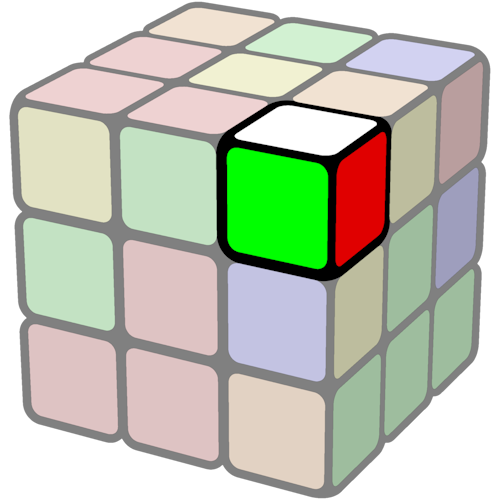 |
| (R U2 R') U' (R U R') | ||
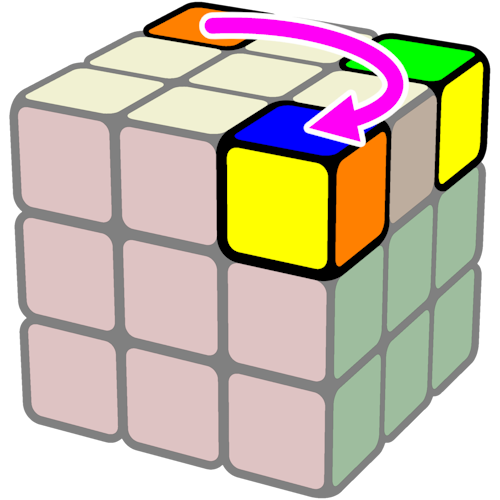
| 6 | rotate up-layer so only 1 corner is in the correct location then: | |
|  | |
|  | |
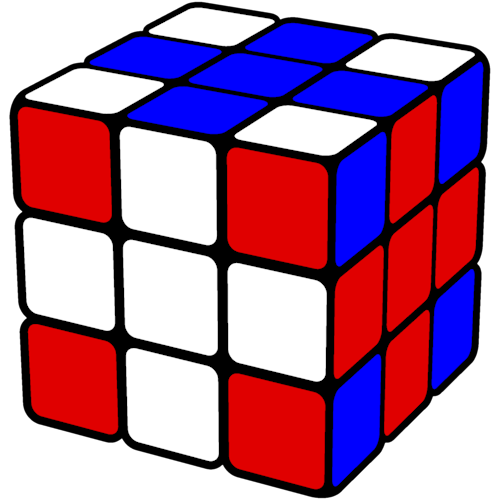
Gift wrap: move all the corners of the F, U and R faces clockwise:
 |  |  | |  |
|---|
“Superflip”: flip every edge piece:
 | |  |
|---|
Note: there are many versions of this algorithm (e.g. below) but I think like the one above as the moves are effectively R U R U' e.g. M' & x are both in the R direction
effectively: R U U' F'
effectively: R' U' U' R
effectively: R' U' U F'
effectively: U R R' U
Note: an easy way to do M' is Rw R'
- reverse it by repeating the algorithm from any orientation!
Also: (...)3 = repeat (...) 3 times
Simply follow steps 3, 6 and 7 for the 3x3x3 cube above.
This is the ‘Reduction Method’ which makes it behave like a 3x3x3 cube - then we can use the 3x3x3 steps above:
- solve the centres (step 1)
- pair the edges (steps 2 & 3)
- solve like a 3x3x3 (instances which can't happen on a 3x3x3 are fixed by steps 4 & 5)
| 1 | white 2x2 centre yellow 2x2 centre (opposite white) other 2x2 centres (use a white or yellow corner to check which color goes on which side) | |
| 2 | white edges non-yellow edges: - position 2 edge pieces so that Lw' or Rw would complete the edge, then: | |
| Lw' or Rw U or U' replace the complete edge with a non-complete edge (using Ln or Rn ) then reverse the previous 2 moves | ||
| 3 | last 2 unsolved edges: - position identical edge pieces so they have the same colour on the F face (as in the diagram) then: |  |
| Uw' (R U R') (F R' F' R) Uw Note: the bit between Uw' & Uw flips the F/R edge 180° To mirror it (i.e. flip the F/L edge): Uw (L' U' L) (F' L F L') Uw' | ||
| or | ||
| 3 | last 3 unsolved edges:
- position 2 edge pieces as above |  |
| Rw U' R' U Rw' or Lw' U L U' Lw Note: these are exactly the same moves as part 2 above | ||
| 4 | final layer - no yellow bar or ‘L’ shape: |  |
| Rw U2 x (Rw U2)2 (Rw' U2 Lw U2 Rw' U2) Rw U2 Rw' U2 Rw' Note: every right wide (and one left wide) is separated by an U2 | ||
| 5 | final layer - 2 adjacent or opposite yellow edges: | 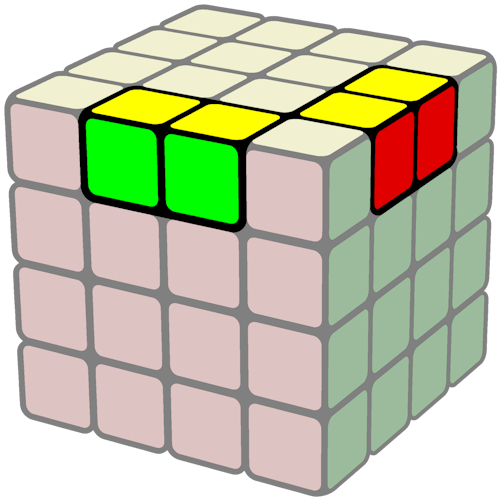 |
|
Note: an easy way to do r2 is Rw2 R2' | ||
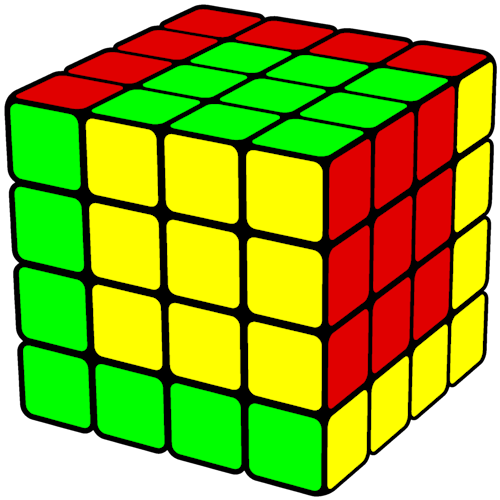
3x3x3 cube in a cube: move the outside F, U and R faces clockwise:
 | |  | |  |
|---|
Note: also works for a 3x3x3 cube
Also: make these all ‘w’ (wide) moves and it will make a 2x2x2 cube in a cube!
Stripey sides:
 | |  |
|---|
This is the ‘Reduction Method’ which is very similar (but easier) to the 4x4x4 steps above:
- solve the centres (step 1)
- pair the edges (steps 2, 3 & 4)
- solve like a 3x3x3 (unlike the 4x4x4, once you get to this stage it's plain sailing)
| • | for each 3x3 centre: first complete the 3 across the middle, then one edge and then the other | |
| 1 | white 3x3 centre | |
tip: to complete the last 3x3 edge: with 1 corner on the correct face, put the other 2 together on an adjacent face | ||
| 1a | last 2 adjacent centres each with 1 piece unsolved: - middle pieces: position unsolved pieces on the left of the F and U faces, then: Lw F' M F Lw' F' M' | |
- corner pieces: position unsolved pieces in the top-right of the F and U faces, then: Rw' F' Lw F Rw F' Lw' | ||
| 2 | white edges non-yellow edges: | |
Note: you can do just 2 or all 3 edge pieces at a time | ||
| 3 | last 2 unsolved edges: - use the same method as 4x4x4 to move edge piece(s) to the opposite side of the F face and flip the edge 180° | |
| 4 | final edge - correct pieces but not orientation: | |
| Rw U2 x (Rw U2)2 (3Rw' U2 Lw U2 Rw' U2) Rw U2 Rw' U2 Rw' Note: same as the 4x4x4 algorithm exept for the ‘3’ | ||
“Superflip”: flip every edge piece:
Note: very similar to 3x3x3 Superflip
- reverse it from any orientation - but do the bottom line first!
Half “Superflip”: flip the edge pieces of the U, R and B faces:
Note: easily mixed up with the Superflip
- reverse it by doing the bottom line first making sure one mixed-up corner is at the U/R/B corner
Where pieces need to be rearranged to fit the reduction method.
flip U/F outer edge pieces 180°
- use to complete the last edge
- every Rw and Lw is separated by an U2
- all these algorithms are basically the same!
4x4x4
Rw U2 x (Rw U2)2 (Rw' U2 Lw U2 Rw' U2) Rw U2 Rw' U2 Rw'
Note: Rw is the same as 2Rw
5x5x5
Rw U2 x (Rw U2)2 (3Rw' U2 Lw U2 Rw' U2) Rw U2 Rw' U2 Rw'
6x6x6
Rw U2 x (Rw U2)2 (4Rw' U2 Lw U2 Rw' U2) Rw U2 Rw' U2 Rw'
7x7x7
and
Rw U2 x (Rw U2)2 (5Rw' U2 Lw U2 Rw' U2) Rw U2 Rw' U2 Rw'
3Rw U2 x (3Rw U2)2 (4Rw' U2 3Lw U2 3Rw' U2) 3Rw U2 3Rw' U2 3Rw'
flip the whole U/F edge 180°
- use to create the yellow cross
- only applies to even cubes
4x4x4
Rw U2 x (Rw U2)2 (Rw' U2 Lw U2 Rw' U2) Rw U2 Rw' U2 Rw'
Note: Rw and Lw is half of the cube.
Also: this is the same as the algorithm above as the outside edge pieces of a 4x4x4 is the whole edge (included for completeness and comparison)
6x6x6
3Rw U2 x (3Rw U2)2 (3Rw' U2 3Lw U2 3Rw' U2) 3Rw U2 3Rw' U2 3Rw'
Note: actually the same as 4x4x4 in that each nRw or nLw is half the cube.
swap the F and B edges of the U layer
- keeps the rest of the U face (& layer) intact
- use to finish the last layer
- only applies to even cubes
4x4x4
Note: remember r is the inside right layer (r = Rw2 R2).
6x6x6
(3Rw2 F2 U2) (3Rw2 R2 U2 F2) 3Rw2
Cube links
- UKSpeedCubes.co.uk - shop with great “Improvement Zone”
- TheDukeOfCubes.com - a website of amazing cube patterns
- www.GRubiks.com - nice simulator, solver
- Cube-Solver.com - nicely animated cube simulator (but can’t turn cube all the way over and solver uses lots of moves)
- RubiksCu.be - simulator, solver, guide, timer
- RuWix.com - wikis, simulators, solvers, guides, timers
- Rubiks-Cube-Solver.com - solver, guide
- www.Calculators.org - 3x3x3 simulator only
Note: shorter algorithms exist for some scenarios on this page but I like these as they’re easier to remember


